

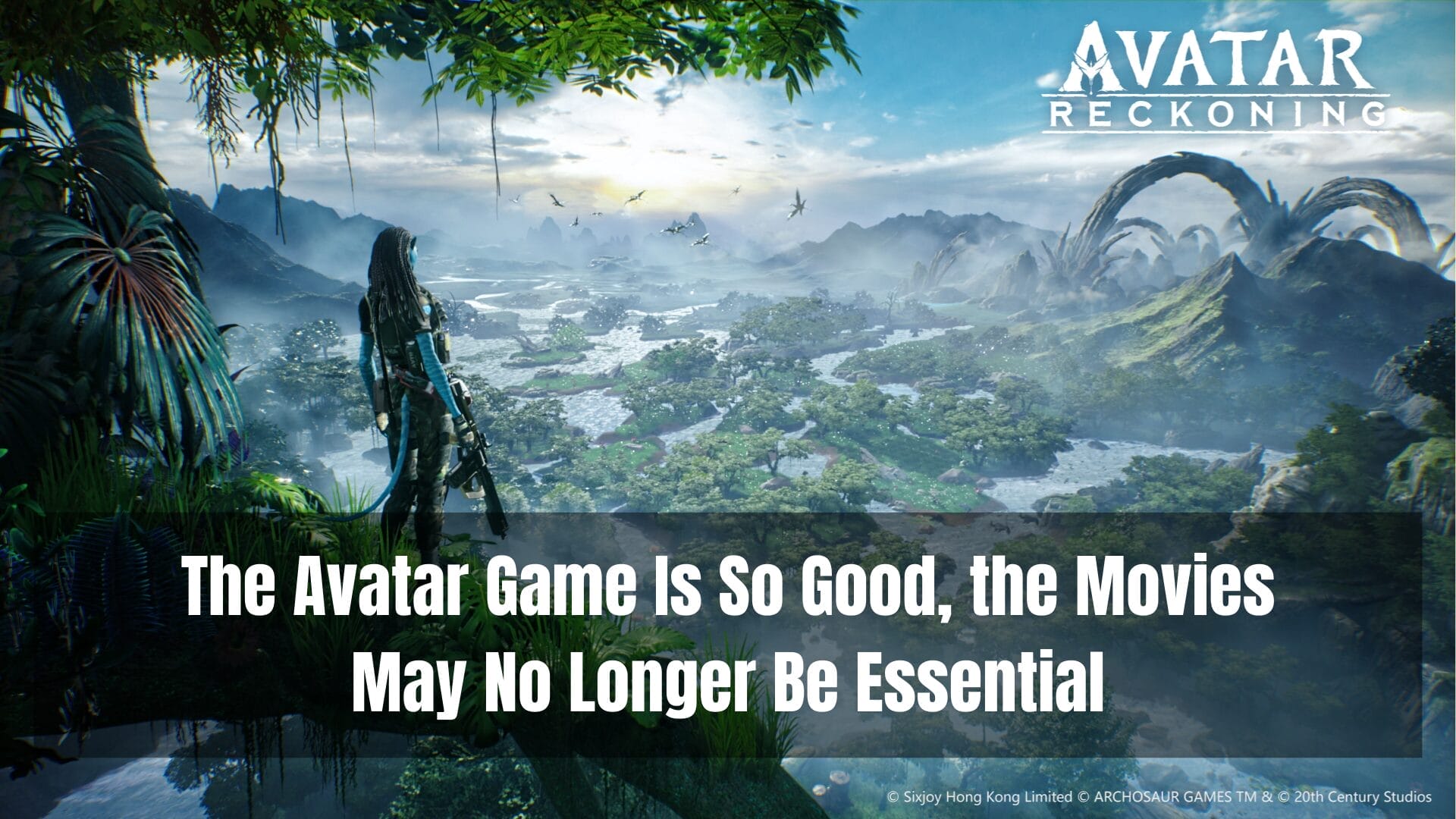
This Avatar Frontiers of Pandora review explores how the video game adaptation delivers a more immersive and effective Avatar experience than the film series by turning Pandora into a fully interactive world.
With the release of Avatar: Frontiers of Pandora, that imbalance may finally have shifted. The video game adaptation, developed by Massive Entertainment and published by Ubisoft, delivers an experience that arguably fulfills the franchise’s core promise more effectively than the films themselves. By allowing players to inhabit Pandora directly—rather than merely observe it—the game reframes Avatar as an interactive world first and a cinematic spectacle second.
A Franchise Defined by Worldbuilding
Criticism of Avatar has remained remarkably consistent since the release of the original film in 2009. The narrative has often been described as derivative, the characters as thinly sketched, and the runtime as excessive. The third installment, Avatar: Fire and Ash, reportedly exceeds three hours, reinforcing long-standing complaints about indulgence and pacing.
Yet these criticisms have never prevented audiences from returning. The Avatar films continue to dominate the global box office, suggesting that their appeal lies less in story mechanics and more in environmental immersion. Pandora—a bioluminescent alien moon filled with dense jungles, strange fauna, and alien ecosystems—has always been the franchise’s true protagonist.
Frontiers of Pandora recognizes this fact and builds its entire design philosophy around it.
An Interactive Pandora
Released in 2023, Avatar: Frontiers of Pandora places players in the role of a Na’vi, the indigenous species of Pandora, standing roughly 10 feet tall and deeply connected to the planet’s ecology. Unlike the films, which follow a fixed narrative arc centered on family, legacy, and conflict, the game emphasizes exploration, autonomy, and environmental interaction.
Rather than passively watching Pandora unfold, players move through it at their own pace—climbing massive trees, navigating hostile flora, bonding with wildlife, and dismantling human industrial outposts. The experience transforms Pandora from a cinematic backdrop into a living system that responds to player action.
Although the game launched to modest attention and mixed reviews, it has since developed a dedicated fan base. Over time, it has received substantial post-launch support, including downloadable content expansions and a free update that allows players to switch from a first-person perspective to a third-person view. This change, while cosmetic, reinforces the fantasy of inhabiting a Na’vi body and highlights the game’s detailed character and animation work.
A new downloadable story expansion, From the Ashes, was released alongside the third Avatar film, further aligning the game with the franchise’s evolving timeline.

Environmental Conflict as Gameplay
At its core, Frontiers of Pandora functions as an ecological conflict simulator. Human colonizers extract resources, pollute the environment, and establish fortified industrial zones. The player’s role is to dismantle these operations, restore damaged ecosystems, and reestablish balance.
As hostile encampments are destroyed, the surrounding environment visibly regenerates. Polluted land clears, plant life returns, and wildlife reappears. This mechanic reinforces Avatar’s long-standing environmental themes in a way that film cannot easily replicate. The player is not simply told that nature is worth protecting; they witness the consequences of both exploitation and restoration in real time.
The surrounding environment is intentionally hostile as well as beautiful. Many plants are reactive, aggressive, or lethal, emphasizing Pandora’s status as a living system rather than a decorative landscape. Movement through the world involves constant interaction—jumping across glowing lily pads, navigating collapsing vegetation, and adapting to unpredictable terrain.
Lore, Consistency, and “Science Fact”
One of the most notable achievements of Frontiers of Pandora is its commitment to internal consistency. The game’s narrative and environmental systems were developed in close collaboration with Lightstorm Entertainment, ensuring alignment with the films’ canon.
Jennifer Bartram, Massive Entertainment’s senior narrative coordinator, served as the project’s lore authority. Her role involved maintaining continuity between the films and the game while grounding Pandora’s biology and technology in speculative science.
The Avatar universe has long been described by its creators as “science fact” rather than traditional science fiction. Every creature, plant, and technological system is designed with an evolutionary or biological rationale. In the game, this philosophy manifests through environmental storytelling, in-world documentation, and ecological mechanics that make Pandora feel coherent rather than fantastical for its own sake.

Familiar Criticisms, Reframed
Many of the criticisms leveled at the Avatar films also apply to Frontiers of Pandora. The central narrative lacks complexity, and supporting characters are quickly forgotten. The game’s length and scale may feel excessive to players seeking a tightly paced experience.
However, these weaknesses are less damaging in an interactive format. When story is optional and exploration is self-directed, narrative thinness becomes less intrusive. The game succeeds not by telling a compelling story, but by providing space for players to create their own.
According to lead game designer Amandine Lauer, this balance was intentional. The films and the game were designed to coexist without competing for narrative authority. Both share the same thematic DNA while offering different ways to engage with the world.
Avatar as an Interactive Fantasy
The game has also been embraced by the Avatar fan community, including long-standing fan organizations such as Kelutral. Fans who were initially skeptical of a game adaptation have since adopted Frontiers of Pandora as a central part of the franchise experience.
The Avatar universe has always functioned as an escapist fantasy—an idealized, ecologically balanced world contrasted against human industrial excess. As an interactive experience, that fantasy becomes more potent. Players are not just observing a better world; they are actively sustaining it.
The franchise’s resistance to generative AI tools has further strengthened this appeal. James Cameron has publicly emphasized human-driven artistry and technical craftsmanship, aligning Avatar with a broader cultural pushback against automated creative production.
A Finite Cinematic Resource
With plans for additional Avatar films still contingent on audience reception, questions remain about the franchise’s cinematic future. The films demand significant time investment and rely heavily on spectacle to justify their length.
Frontiers of Pandora, by contrast, offers a persistent world that can be revisited indefinitely. Its scale and openness allow for short sessions or extended immersion, adapting to the player rather than demanding endurance.
In this sense, the game may represent the most sustainable future for the Avatar franchise. Pandora works best as a place to inhabit, not just a story to watch. Interactive media allows the franchise’s strengths—worldbuilding, environmental design, and sensory immersion—to take precedence over its narrative limitations.
Conclusion
Avatar: Frontiers of Pandora demonstrates that the Avatar franchise reaches its full potential when it abandons rigid storytelling in favor of player-driven exploration. By transforming Pandora into an interactive ecosystem rather than a cinematic backdrop, the game delivers an experience that feels more authentic to the franchise’s core identity.
While future films may continue to draw massive audiences, the game suggests that Avatar no longer depends on cinema alone. As a living, explorable world, Pandora finally becomes what it was always meant to be.
References
- Ubisoft – Avatar: Frontiers of Pandora Official Site
https://www.ubisoft.com - Massive Entertainment – Studio Background and Development Philosophy
https://www.massive.se - Lightstorm Entertainment – Avatar Franchise Overview
https://www.lightstorm.com - Cameron, J. – Public Statements on Avatar Worldbuilding and AI
Various interviews, 2023–2024 - Game Informer & IGN – Post-Launch Coverage and DLC Updates
Disclaimer
NextNews strives for accurate tech news, but use it with caution - content changes often, external links may be iffy, and technical glitches happen. See full disclaimer for details.