

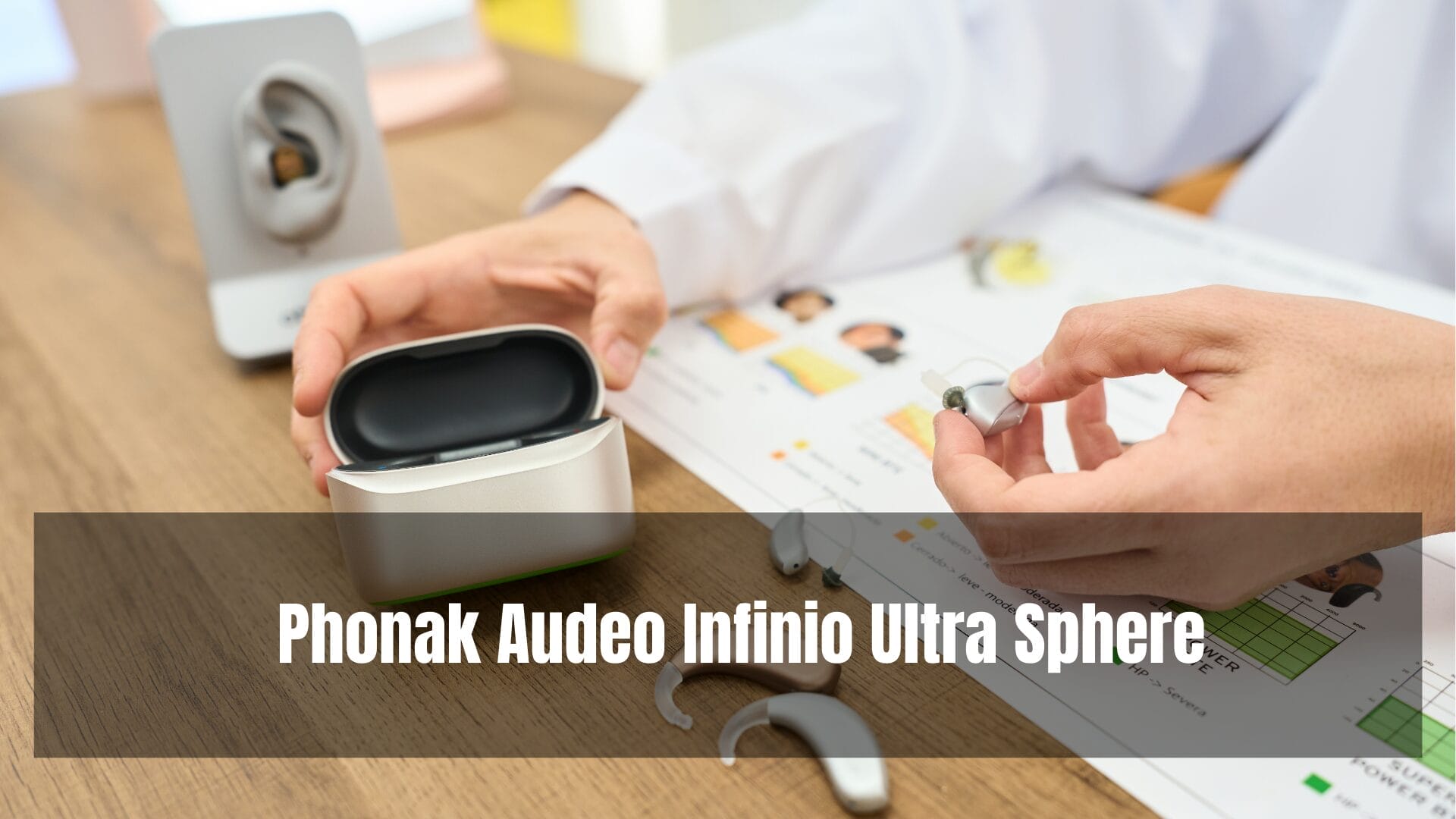
The Phonak Audeo Infinio Ultra Sphere review examines one of Phonak’s most advanced hearing aids to date, focusing on its dual-chip architecture, speech clarity technology, and real-world performance in complex listening environments.
Despite the futuristic branding, the Ultra Sphere does not feature a spherical design. Instead, it adopts a familiar behind-the-ear (BTE) form factor with a teardrop-shaped housing.
The “Sphere” naming refers not to its physical appearance, but to the internal Spheric Speech Clarity 2.0 system, which is designed to analyze and enhance speech from multiple directions simultaneously.
This distinction matters, as it underscores where Phonak has chosen to innovate: not through radical hardware redesign, but through computational audio processing.
Design and Physical Characteristics
Visually, the Ultra Sphere is larger than many contemporary BTE hearing aids. This increase in size is a direct result of its internal architecture, which incorporates two separate processing chips rather than one.
Each unit weighs approximately 3.39 grams, noticeably heavier than devices such as the Jabra Enhance Select 700 or the Horizon Go 7IX, which weigh closer to the mid-2-gram range.
Despite the added bulk, the design remains streamlined and functional. The larger housing does not significantly compromise comfort during extended wear, and the curvature sits naturally behind the ear.
For users accustomed to modern BTE devices, the Ultra Sphere’s profile may be more visible, but it does not feel unwieldy or awkward in daily use.
Control is handled via a two-way rocker button on each device, allowing for power control, volume adjustment, and media navigation. Tap gestures are supported for certain Bluetooth functions, though these are disabled by default in the MyPhonak app.
The hearing aids carry an IP68 rating, meaning they are dust-tight and resistant to water immersion—an important consideration for long-term durability.
Color options include seven finishes, allowing users to choose between discreet or more visible styles. During fitting, users can also select from various eartip configurations, including open domes, closed domes, or Phonak’s EasyGuard wax-resistant domes, depending on comfort and acoustic needs.

Phonak Audeo Infinio Ultra Sphere Review: Design and Technology Overview
The defining feature of the Ultra Sphere is its dual-chip system. Most hearing aids rely on a single processor to manage sound input, noise reduction, wireless connectivity, and environmental adaptation. The Ultra Sphere separates these responsibilities.
At its core is Phonak’s Era chip, introduced in 2024, which manages baseline audio processing, device controls, and Bluetooth connectivity.
Alongside it sits the new DeepSonic DNN (Deep Neural Network) chip, dedicated exclusively to speech detection and enhancement in noisy environments.
This division allows the hearing aid to continuously analyze incoming sound from multiple directions and distinguish speech from background noise more efficiently.
In real-world environments—crowded cafés, group conversations, and public spaces—the Ultra Sphere demonstrates a noticeable improvement in speech clarity compared to conventional single-chip designs.
Background noise is softened without eliminating environmental awareness entirely, preserving a natural listening experience rather than creating an artificial sense of isolation.
Performance in Quiet and Noisy Settings
The Ultra Sphere performs particularly well in noisy conditions, where its advanced processing delivers measurable benefits.
Interestingly, performance in near-silent environments reveals a minor trade-off. In very quiet rooms, a faint intermittent hiss can occasionally be detected. While subtle, it is a characteristic worth noting for those sensitive to background artifacts.
Overall amplification is well-balanced. The device avoids over-boosting sound and instead provides a controlled, supportive listening experience. Speech during television viewing and face-to-face conversations is enhanced without overwhelming the listener.
High-frequency sounds such as keyboard clicks or mouse taps can occasionally register as sharper than ideal, though this is typically correctable through follow-up tuning with an audiologist.
Bluetooth, Streaming, and Connectivity
Bluetooth performance on the Ultra Sphere is strong for a BTE hearing aid. Music streaming and phone calls are clear, with minimal distortion.
Connectivity is generally stable, though brief dropouts may occur during longer listening sessions. These interruptions are infrequent and do not significantly detract from usability, but they highlight the ongoing limitations of Bluetooth performance in hearing aids compared to dedicated wireless headphones.
Comfort and Battery Life
Despite its larger size, the Ultra Sphere excels in comfort. Extended wear over multiple hours does not lead to pressure points or fatigue, even for users who also wear glasses—an area where many BTE devices struggle.
Battery performance is another standout feature. Phonak advertises up to 56 hours of use per charge, depending on streaming and processing demands. In mixed-use scenarios that include Bluetooth streaming and active noise processing, real-world battery life is closer to the mid-20-hour range, which remains competitive for a device of this complexity.
The included ChargerGo case provides multiple full recharges, making it suitable for travel or extended periods away from power outlets.
Accessories and Peripheral Ecosystem
Phonak offers a range of accessories designed to extend the Ultra Sphere’s capabilities. The TV Connector, priced at approximately $320, streams audio directly from a television to the hearing aids, bypassing room acoustics and reducing reliance on ambient amplification. Functionally, it operates similarly to emerging broadcast technologies like Auracast.
More advanced—and significantly more expensive—is the Roger On 3 microphone system. Retailing between $1,800 and $2,000, this portable microphone can operate in unidirectional or omnidirectional modes.
While extremely powerful, the Roger system requires careful configuration. It is highly sensitive and may capture unintended sounds such as clothing movement or background noise between the microphone and the target source. Effective use demands patience and practice.
Pricing and Market Position
The Phonak Audeo Infinio Ultra Sphere is priced at approximately $4,000, available exclusively through licensed audiologists. Pricing varies based on provider services, fitting, and follow-up care.
Final Assessment
The Phonak Audeo Infinio Ultra Sphere is a technically impressive hearing aid that prioritizes speech clarity through computational intelligence rather than cosmetic redesign. Its dual-chip architecture delivers meaningful improvements in noisy environments, while comfort, battery life, and accessory support remain strong.
Minor drawbacks—such as occasional hiss in quiet settings and high cost—do not overshadow its strengths, but they do reinforce that this device is best suited for users with specific, demanding listening needs rather than casual amplification.
For those seeking one of the most advanced prescription hearing aids currently available, the Ultra Sphere stands as a compelling, if expensive, option.
References
- Phonak Official Product Page – Audeo Infinio Ultra
https://www.phonak.com - Phonak Technical White Papers – Deep Neural Network Processing
https://www.phonakpro.com - U.S. FDA – Hearing Aid Types and Regulations
https://www.fda.gov - Consumer Reports – Hearing Aid Technology and Buying Guides
https://www.consumerreports.org - AudiologyOnline – Advances in Directional and Neural Hearing Aid Systems
https://www.audiologyonline.com
https://nextnews.com.au/ai/ai-generated-art-2026/
Disclaimer
NextNews strives for accurate tech news, but use it with caution - content changes often, external links may be iffy, and technical glitches happen. See full disclaimer for details.